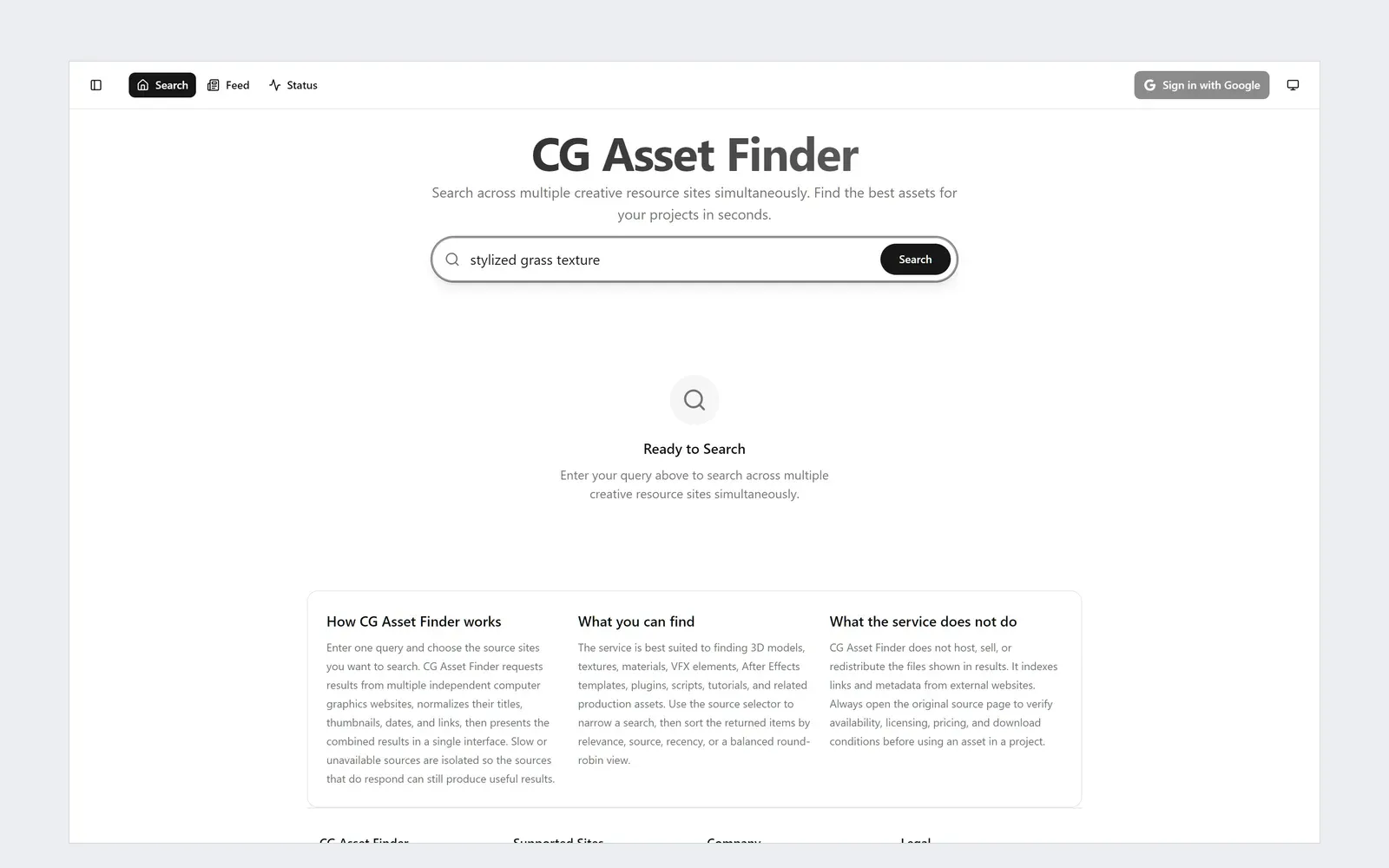
The problem
Motion designers and 3D artists hunt for the same plugin, template or model across a dozen sites, each with its own search, and some of them in Chinese.
What it does
- One query goes to 17 sites at once, and results stream in site by site as each one answers.
- Sort by relevance, round-robin across sites, by site or newest first, in a grid or a list.
- Queries to the four Chinese sites are translated automatically, with a cache and a silent fallback to the original words.
- A feed collects new posts from five sources every 30 minutes and tags them by asset type and software with explainable rules instead of a language model.
- A status page checks every source every five minutes.
How it’s built
- FastAPI streams results over server-sent events. One orchestrator reuses connection pools and fans the query out to a parser per site, built on three base types: HTML pages, the WordPress API and translated search.
- Failure isolation is the rule. A slow or broken site never breaks a search, and a headless browser starts only when a site answers with a bot check, one job at a time.
- Streaming works end to end through nginx, with buffering switched off in both the app and the proxy.
- A React 19 front end with pre-rendered pages for search engines, plus
llms.txtand Markdown versions of pages for AI agents. - Docker Compose on my own server, deployed from GitHub Actions with rollback snapshots.
By the numbers
- About 260 commits, from November 2025 to September 2026.
- About 17,000 lines of Python and TypeScript and 660 automated tests.
Status
Live since late 2025. It links to the original pages and doesn’t host or redistribute files.